Study Spanish Art Sketchbookcollage Math Hw Read American Lit Book History Project


The Tale of Genji, Beowulf, Ballsy of Gilgamesh, Pāli Canon, The Grapes of Wrath, Things Autumn Apart, War and Peace, One Yard and One Nights, Cien Años de Soledad, Dresden Codex, Xiping Stone Classics
Literature broadly is any collection of written piece of work, but it is likewise used more narrowly for writings specifically considered to be an fine art course, specially prose fiction, drama, and poetry.[1] In recent centuries, the definition has expanded to include oral literature, much of which has been transcribed.[2] Literature is a method of recording, preserving, and transmitting knowledge and entertainment, and tin too accept a social, psychological, spiritual, or political role.
Literature, as an art form, can also include works in various non-fiction genres, such every bit biography, diaries, memoir, letters, and the essay. Within its broad definition, literature includes non-fictional books, manufactures or other printed information on a particular subject.[three] [4]
Etymologically, the term derives from Latin literatura/litteratura "learning, a writing, grammar," originally "writing formed with letters," from litera/littera "letter".[5] In spite of this, the term has also been applied to spoken or sung texts.[6] [7] Developments in print technology have immune an always-growing distribution and proliferation of written works, which now includes electronic literature.
Literature is classified according to whether it is poetry, prose or drama, and such works are categorized according to historical periods, or their adherence to certain aesthetic features, or genre.
Definitions [edit]
Definitions of literature have varied over time.[8] In Western Europe, prior to the 18th century, literature denoted all books and writing literature can be seen every bit returning to older, more inclusive notions, so that cultural studies, for instance, include, in addition to canonical works, popular and minority genres. The discussion is also used in reference non-written works: to "oral literature" and "the literature of preliterate culture".
A value judgment definition of literature considers it as consisting solely of high quality writing that forms part of the belles-lettres ("fine writing") tradition.[9] An example of this in the (1910–11) Encyclopædia Britannica that classified literature as "the all-time expression of the best thought reduced to writing".[ten]
History [edit]
Oral literature [edit]
The use of the term "literature" here is a niggling problematic because of its origins in the Latin littera, "letter," essentially writing. Alternatives such as "oral forms" and "oral genres" accept been suggested but the word literature is widely used.[11]
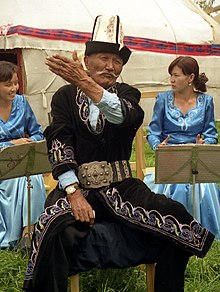
Oral literature is an aboriginal human tradition found in "all corners of the world".[12] Modernistic archaeology has been unveiling evidence of the human efforts to preserve and transmit arts and knowledge that depended completely or partially on an oral tradition, across various cultures:
The Judeo-Christian Bible reveals its oral traditional roots; medieval European manuscripts are penned by performing scribes; geometric vases from archaic Greece mirror Homer'southward oral style. (...) Indeed, if these final decades of the millennium have taught u.s.a. anything, information technology must be that oral tradition never was the other we accused information technology of being; it never was the primitive, preliminary technology of communication we idea it to be. Rather, if the whole truth is told, oral tradition stands out as the single most dominant communicative applied science of our species as both a historical fact and, in many areas withal, a contemporary reality.[12]
The earliest verse is believed to have been recited or sung, employed as a way of remembering history, genealogy, and police force.[13]
In Asia, the transmission of folklore, mythologies as well as scriptures in aboriginal India, in dissimilar Indian religions, was by oral tradition, preserved with precision with the help of elaborate mnemonic techniques.[14]
The early on Buddhist texts are also more often than not believed to exist of oral tradition, with the get-go past comparison inconsistencies in the transmitted versions of literature from various oral societies such as the Greek, Serbia and other cultures, so noting that the Vedic literature is too consequent and vast to have been composed and transmitted orally across generations, without being written down.[ citation needed ] Co-ordinate to Goody, the Vedic texts likely involved both a written and oral tradition, calling it a "parallel products of a literate club".[ citation needed ]
Australian Ancient culture has thrived on oral traditions and oral histories passed down through thousands of years. In a study published in Feb 2020, new evidence showed that both Budj Bim and Belfry Hill volcanoes erupted between 34,000 and forty,000 years agone.[15] Significantly, this is a "minimum age constraint for human presence in Victoria", and also could be interpreted as show for the oral histories of the Gunditjmara people, an Aboriginal Australian people of s-western Victoria, which tell of volcanic eruptions beingness some of the oldest oral traditions in beingness.[16] An axe plant underneath volcanic ash in 1947 had already proven that humans inhabited the region before the eruption of Belfry Hill.[15]
All ancient Greek literature was to some degree oral in nature, and the primeval literature was completely so.[17] Homer'southward epic verse, states Michael Gagarin, was largely composed, performed and transmitted orally.[18] As folklores and legends were performed in front of afar audiences, the singers would substitute the names in the stories with local characters or rulers to give the stories a local flavor and thus connect with the audience, but making the historicity embedded in the oral tradition as unreliable.[xix] The lack of surviving texts about the Greek and Roman religious traditions accept led scholars to presume that these were ritualistic and transmitted as oral traditions, but some scholars disagree that the complex rituals in the aboriginal Greek and Roman civilizations were an exclusive production of an oral tradition.[20]
Writing systems are not known to have existed among Native North Americans before contact with Europeans. Oral storytelling traditions flourished in a context without the use of writing to record and preserve history, scientific cognition, and social practices.[21] While some stories were told for amusement and leisure, most functioned as practical lessons from tribal experience applied to immediate moral, social, psychological, and environmental issues.[22] Stories fuse fictional, supernatural, or otherwise exaggerated characters and circumstances with real emotions and morals as a means of instruction. Plots often reflect real life situations and may be aimed at particular people known by the story's audience. In this way, social pressure could be exerted without directly causing embarrassment or social exclusion.[23] For example, rather than yelling, Inuit parents might deter their children from wandering too close to the h2o's edge by telling a story virtually a sea monster with a pouch for children within its accomplish.[24]
Come across also African literature#Oral literature
Oratory [edit]
Oratory or the art of public speaking "was for long considered a literary art".[3] From Ancient Hellenic republic to the tardily 19th century, rhetoric played a cardinal role in Western education in training orators, lawyers, counsellors, historians, statesmen, and poets.[25] [notation 1]
Writing [edit]
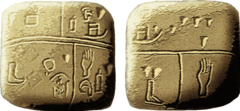
Around the 4th millennium BC, the complication of trade and administration in Mesopotamia outgrew human memory, and writing became a more dependable method of recording and presenting transactions in a permanent grade.[27] Though in both ancient Egypt and Mesoamerica, writing may have already emerged because of the need to tape historical and environmental events. Subsequent innovations included more uniform, predictable, legal systems, sacred texts, and the origins of modern practices of scientific enquiry and knowledge-consolidation, all largely reliant on portable and hands reproducible forms of writing.
Early written literature [edit]
Ancient Egyptian literature,[28] along with Sumerian literature, are considered the world's oldest literatures.[29] The chief genres of the literature of ancient Egypt—didactic texts, hymns and prayers, and tales—were written almost entirely in verse;[30] By the Sometime Kingdom (26th century BC to 22nd century BC), literary works included funerary texts, epistles and letters, hymns and poems, and commemorative autobiographical texts recounting the careers of prominent administrative officials. It was non until the early on Eye Kingdom (21st century BC to 17th century BC) that a narrative Egyptian literature was created.[31]
Many works of early on periods, even in narrative course, had a covert moral or didactic purpose, such as the Sanskrit Panchatantra.200 BC – 300 AD, based on older oral tradition.[32] [33] Drama and satire likewise developed equally urban civilisation provided a larger public audience, and later readership, for literary production. Lyric poetry (as opposed to epic poetry) was oftentimes the speciality of courts and aristocratic circles, particularly in East Asia where songs were nerveless past the Chinese aristocracy as poems, the most notable being the Shijing or Book of Songs (1046–c.600 BC), .[34] [35] [36]
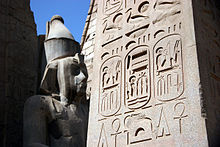
In ancient China, early literature was primarily focused on philosophy, historiography, armed forces science, agriculture, and verse. China, the origin of mod newspaper making and woodblock printing, produced the world'south beginning print cultures.[37] Much of Chinese literature originates with the Hundred Schools of Idea period that occurred during the Eastern Zhou Dynasty (769‒269 BC).[38] The nearly of import of these include the Classics of Confucianism, of Daoism, of Mohism, of Legalism, too equally works of military science (eastward.1000. Sunday Tzu's The Art of War, c.5th century BC)) and Chinese history (e.yard. Sima Qian'south Records of the Grand Historian, c.94 BC). Ancient Chinese literature had a heavy emphasis on historiography, with often very detailed court records. An exemplary piece of narrative history of aboriginal China was the Zuo Zhuan, which was compiled no later than 389 BC, and attributed to the blind fifth-century BC historian Zuo Qiuming.[39]
In ancient Republic of india, literature originated from stories that were originally orally transmitted. Early genres included drama, fables, sutras and epic poetry. Sanskrit literature begins with the Vedas, dating dorsum to 1500–1000 BC, and continues with the Sanskrit Epics of Iron Age Bharat.[twoscore] [41] The Vedas are among the oldest sacred texts. The Samhitas (vedic collections) date to roughly 1500–1000 BC, and the "circum-Vedic" texts, as well as the redaction of the Samhitas, appointment to c. 1000‒500 BC, resulting in a Vedic period, spanning the mid-2nd to mid 1st millennium BC, or the Tardily Statuary Historic period and the Iron Age.[42] The catamenia between approximately the 6th to 1st centuries BC saw the composition and redaction of the 2 most influential Indian epics, the Mahabharata [43] [44] and the Ramayana,[45] with subsequent redaction progressing down to the quaternary century AD. Other major literary works are Ramcharitmanas[46] & Krishnacharitmanas.
The earliest known Greek writings are Mycenaean (c.1600–1100 BC), written in the Linear B syllabary on clay tablets. These documents comprise prosaic records largely concerned with merchandise (lists, inventories, receipts, etc.); no real literature has been discovered.[47] [48] Michael Ventris and John Chadwick, the original decipherers of Linear B, state that literature almost certainly existed in Mycenaean Hellenic republic,[48] but it was either non written down or, if it was, information technology was on parchment or wooden tablets, which did not survive the devastation of the Mycenaean palaces in the 12th century BC.[48] Homer's, epic poems the Iliad and the Odyssey, are central works of ancient Greek literature. It is generally accepted that the poems were composed at some signal effectually the tardily eighth or early seventh century BC.[49] Modern scholars consider these accounts legendary.[50] [51] [52] Most researchers believe that the poems were originally transmitted orally.[53] From antiquity until the present day, the influence of Homeric epic on Western culture has been great, inspiring many of its most famous works of literature, music, art and film.[54] The Homeric epics were the greatest influence on ancient Greek culture and education; to Plato, Homer was simply the one who "has taught Greece" – x Hellada pepaideuken.[55] [56] Hesiod's Works and Days (c.700 BC) and Theogony, are some of the earliest, and most influential, of aboriginal Greek literature. Classical Greek genres included philosophy, poetry, historiography, comedies and dramas. Plato (428/427 or 424/423 – 348/347 BC) and Aristotle (384–322 BC) authored philosophical texts that are the foundation of Western philosophy, Sappho (c. 630 – c. 570 BC) and Pindar were influential lyric poets, and Herodotus (c. 484 – c. 425 BC) ) and Thucydides were early Greek historians. Although drama was popular in ancient Hellenic republic, of the hundreds of tragedies written and performed during the classical age, only a limited number of plays by three authors nevertheless exist: Aeschylus, Sophocles, and Euripides. The plays of Aristophanes (c. 446 – c. 386 BC) provide the only real examples of a genre of comic drama known every bit Quondam Comedy, the earliest form of Greek Comedy, and are in fact used to define the genre.[57]
The Hebrew religious text, the Torah, is widely seen as a product of the Persian catamenia (539–333 BC, probably 450–350 BC).[58] This consensus echoes a traditional Jewish view which gives Ezra, the leader of the Jewish community on its render from Babylon, a pivotal role in its promulgation.[59] This represents a major source of Christianity'southward Bible, which has been a major influence on Western literature.[60]
The showtime of Roman literature dates to 240 BC, when a Roman audience saw a Latin version of a Greek play.[61] Literature in latin would flourish for the adjacent six centuries, and includes essays, histories, poems, plays, and other writings.
The Qur'an (610 Advertizement to 632 Advertisement)[62] ), the master holy book of Islam, had a significant influence on the Arab linguistic communication, and marked the start of Islamic literature. Muslims believe information technology was transcribed in the Standard arabic dialect of the Quraysh, the tribe of Muhammad.[23] [63] As Islam spread, the Quran had the outcome of unifying and standardizing Standard arabic.[23]
Theological works in Latin were the dominant form of literature in Europe typically found in libraries during the Middle Ages. Western Colloquial literature includes the Poetic Edda and the sagas, or heroic epics, of Iceland, the Anglo-Saxon Beowulf, and the German language Song of Hildebrandt. A later form of medieval fiction was the romance, an adventurous and sometimes magical narrative with potent popular appeal.[64]
Controversial, religious, political and instructional literature proliferated during the European Renaissance every bit a result of the Johannes Gutenberg'due south invention of the printing press[65] around 1440, while the Medieval romance developed into the novel,[66]
Publishing [edit]

Publishing became possible with the invention of writing, simply became more practical with the invention of printing. Prior to printing, distributed works were copied manually, by scribes.
The Chinese inventor Bi Sheng made movable type of earthenware c. 1045. Then c.1450, separately Johannes Gutenberg invented movable type in Europe. This invention gradually made books less expensive to produce and more widely available.
Early printed books, single sheets and images which were created before 1501 in Europe are known as incunables or incunabula. "A human born in 1453, the year of the autumn of Constantinople, could look back from his fiftieth year on a lifetime in which about eight 1000000 books had been printed, more possibly than all the scribes of Europe had produced since Constantine founded his city in A.D. 330."[67]
Eventually, printing enabled other forms of publishing besides books. The history of modern newspaper publishing started in Germany in 1609, with publishing of magazines following in 1663.
University subject [edit]
In England [edit]
In England in the late 1820s, growing political and social sensation, "especially amid the utilitarians and Benthamites, promoted the possibility of including courses in English literary written report in the newly formed London University". This further developed into the idea of the report of literature being "the ideal carrier for the propagation of the humanist cultural myth of a welleducated, culturally harmonious nation".[68]
America [edit]
American Literature (academic discipline)
Women and literature [edit]
The widespread education of women was non common until the nineteenth century, and because of this literature until recently was mostly male dominated.[69]
George Sand was an idea. She has a unique place in our historic period.
Others are great men ... she was a cracking adult female.
Victor Hugo, Les funérailles de George Sand [lxx]
There are few women poets writing in English, whose names are remembered, until the twentieth century. In the nineteenth century some names that stand up out are Emily Brontë, Elizabeth Barrett Browning, and Emily Dickinson (see American poetry). But while generally women are absent from the European cannon of Romantic literature, there is i notable exception, the French novelist and memoirist Amantine Dupin (1804 – 1876) best known by her pen name George Sand.[71] [72] 1 of the more pop writers in Europe in her lifetime,[73] being more renowned than both Victor Hugo and Honoré de Balzac in England in the 1830s and 1840s,[74] Sand is recognised as one of the almost notable writers of the European Romantic era. Jane Austen (1775 – 1817) is the first major English woman novelist, while Aphra Behn is an early female dramatist.
Nobel Prizes in Literature have been awarded betwixt 1901 and 2020 to 117 individuals: 101 men and 16 women. Selma Lagerlöf (1858 – 1940) was the commencement adult female to win the Nobel Prize in Literature, which she was awarded in 1909. Additionally, she was the first woman to be granted a membership in The Swedish Academy in 1914.[75]
Feminist scholars have since the twentieth century sought expand the literary catechism to include more women writers.
Children's literature [edit]
A split genre of children's literature simply began to emerge in the eighteenth century, with the evolution of the concept of childhood.[76] : 10–xi The primeval of these books were educational books, books on deport, and simple ABCs—oftentimes decorated with animals, plants, and anthropomorphic messages.[77]
Aesthetics [edit]
Literary theory [edit]
A fundamental question of literary theory is "what is literature?" – although many contemporary theorists and literary scholars believe either that "literature" cannot be divers or that it can refer to whatsoever use of language.[78]
Literary fiction [edit]

Literary fiction is a term used to describe fiction that explores any facet of the human status, and may involve social commentary. It is often regarded as having more creative merit than genre fiction, especially the most commercially oriented types, but this has been contested in recent years, with the serious study of genre fiction within universities.[79]
The following, by the award-winning British author William Boyd on the short story, might be applied to all prose fiction:
[brusk stories] seem to answer something very deep in our nature every bit if, for the duration of its telling, something special has been created, some essence of our experience extrapolated, some temporary sense has been made of our common, turbulent journey towards the grave and oblivion.[80]
The very best in literature is annually recognized by the Nobel Prize in Literature, which is awarded to an author from any land who has, in the words of the volition of Swedish industrialist Alfred Nobel, produced "in the field of literature the nearly outstanding work in an platonic direction" (original Swedish: den som inom litteraturen har producerat det mest framstående verket i en idealisk riktning).[81] [82]
The value of imaginative literature [edit]
Some researchers propose that literary fiction tin can play a part in an individual'due south psychological evolution.[83] Psychologists have too been using literature as a therapeutic tool.[84] [85] Psychologist Hogan argues for the value of the time and emotion that a person devotes to understanding a character's situation in literature;[86] that it tin can unite a large community by provoking universal emotions, as well every bit allowing readers access to different cultures, and new emotional experiences.[87] One study, for case, suggested that the presence of familiar cultural values in literary texts played an important impact on the performance of minority students.[88]
Psychologist Maslow's ideas help literary critics sympathise how characters in literature reflect their personal culture and the history.[89] The theory suggests that literature helps an individual's struggle for self-fulfilment.[90] [91]
The influence of religious texts [edit]
![[icon]](https://upload.wikimedia.org/wikipedia/commons/thumb/1/1c/Wiki_letter_w_cropped.svg/20px-Wiki_letter_w_cropped.svg.png) | This department needs expansion. You can aid by calculation to information technology. (November 2020) |
Organized religion has had a major influence on literature, through works similar the Vedas, the Torah, the Bible,[92] and the Qur'an.[93] [94] [95]
The King James Version of the Bible has been called "the almost influential version of the most influential book in the world, in what is at present its most influential language", "the most of import volume in English religion and civilization", and "the most celebrated book in the English-speaking world"[ commendation needed ] - principally considering of its literary style and widespread distribution. Prominent atheist figures such as the belatedly Christopher Hitchens and Richard Dawkins have praised the Rex James Version equally being "a giant stride in the maturing of English literature" and "a corking work of literature", respectively, with Dawkins then adding, "A native speaker of English language who has never read a word of the King James Bible is verging on the barbaric".[96] [97]
Societies in which preaching has swell importance, and those in which religious structures and authorities have a near-monopoly of reading and writing and/or a censorship part, may impart a religious gloss to much of the literature those societies produce or retain - equally for instance in the European Middle Ages. The traditions of shut report of religious texts has furthered the development of techniques and theories in literary studies.
Types of literature [edit]
Poesy [edit]
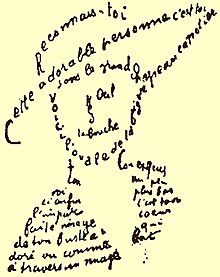
Poetry has traditionally been distinguished from prose by its greater use of the aesthetic qualities of linguistic communication, including musical devices such as assonance, alliteration, rhyme, and rhythm, and by existence set up in lines and verses rather than paragraphs, and more than recently its utilize of other typographical elements.[98] [99] [100] This distinction is complicated by diverse hybrid forms such as sound poetry, concrete poetry and prose poem,[101] and more generally by the fact that prose possesses rhythm.[102] Abram Lipsky refers to it equally an "open secret" that "prose is not distinguished from poetry by lack of rhythm".[103]
Prior to the 19th century, verse was commonly understood to be something fix in metrical lines: "any kind of field of study consisting of Rhythm or Verses".[98] Possibly every bit a outcome of Aristotle's influence (his Poetics), "poesy" before the 19th century was usually less a technical designation for poesy than a normative category of fictive or rhetorical art.[ clarification needed ] [104] As a form it may pre-date literacy, with the primeval works being composed within and sustained by an oral tradition;[105] [106] hence information technology constitutes the earliest example of literature.
Prose [edit]
Every bit noted above, prose generally makes far less utilise of the aesthetic qualities of language than poetry.[99] [100] [107] However, developments in mod literature, including free verse and prose poetry have tended to blur the differences, and American poet T.South. Eliot suggested that while: "the stardom between poetry and prose is clear, the distinction between poetry and prose is obscure".[108] There are poetry novels, a type of narrative poesy in which a novel-length narrative is told through the medium of poetry rather than prose. Eugene Onegin (1831) by Alexander Pushkin is the most famous example.[109]
On the historical development of prose, Richard Graff notes that "[In the instance of aboriginal Greece] recent scholarship has emphasized the fact that formal prose was a insufficiently late evolution, an "invention" properly associated with the classical flow".[110]
Latin was a major influence on the evolution of prose in many European countries. Peculiarly important was the great Roman orator Cicero.[111] It was the lingua franca among literate Europeans until quite recent times, and the great works of Descartes (1596 – 1650), Francis Bacon (1561 – 1626), and Baruch Spinoza (1632 – 1677) were published in Latin. Amidst the concluding of import books written primarily in Latin prose were the works of Swedenborg (d. 1772), Linnaeus (d. 1778), Euler (d. 1783), Gauss (d. 1855), and Isaac Newton (d. 1727).
Novel [edit]
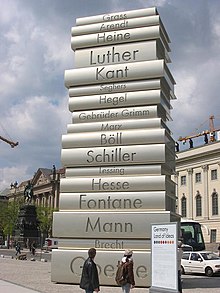
Sculpture in Berlin depicting a stack of books on which are inscribed the names of great German writers.
A novel is a long fictional prose narrative. In English, the term emerged from the Romance languages in the belatedly 15th century, with the meaning of "news"; it came to indicate something new, without a distinction between fact or fiction.[112] The romance is a closely related long prose narrative. Walter Scott divers it equally "a fictitious narrative in prose or poetry; the involvement of which turns upon marvellous and uncommon incidents", whereas in the novel "the events are accommodated to the ordinary train of human events and the modern state of society".[113] Other European languages do not distinguish betwixt romance and novel: "a novel is le roman, der Roman, il romanzo",[114] indicates the proximity of the forms.[115]
Although there are many historical prototypes, and then-called "novels earlier the novel",[116] the modern novel class emerges late in cultural history—roughly during the eighteenth century.[117] Initially subject to much criticism, the novel has acquired a dominant position amid literary forms, both popularly and critically.[115] [118] [119]
Novella [edit]
The publisher Melville House classifies the novella equally "also short to exist a novel, too long to be a short story".[120] Publishers and literary honor societies typically consider a novella to exist betwixt 17,000 and 40,000 words.[121]
Short story [edit]
A dilemma in defining the "curt story" every bit a literary form is how to, or whether one should, distinguish it from whatever short narrative and its contested origin,[122] that include the Bible, and Edgar Allan Poe.[123]
Graphic novel [edit]
Graphic novels and comic books present stories told in a combination of artwork, dialogue, and text.
Electronic literature [edit]
Electronic literature is a literary genre consisting of digital works
Nonfiction [edit]
Common literary examples of nonfiction include, the essay; travel literature and nature writing; biography, autobiography and memoir; journalism; messages; journals; history, philosophy, economics; scientific, and technical writings.[four] [124]
Nonfiction can fall within the broad category of literature as "whatever drove of written work", but some works fall inside the narrower definition "past virtue of the excellence of their writing, their originality and their full general aesthetic and artistic merits".[125]
Drama [edit]
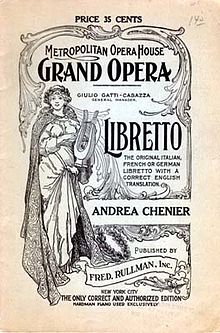
Drama is literature intended for performance.[126] The grade is combined with music and dance in opera and musical theatre (see libretto). A play is a written dramatic work by a playwright that is intended for performance in a theatre; it comprises chiefly dialogue between characters. A closet drama, by contrast, is written to exist read rather than to be performed; the meaning of which can be realized fully on the page.[127] Near all drama took verse course until comparatively recently.
The primeval form of which there exists substantial cognition is Greek drama. This developed as a functioning associated with religious and civic festivals, typically enacting or developing upon well-known historical, or mythological themes,
In the twentieth century scripts written for non-phase media take been added to this form, including radio, television and picture.
Law [edit]
Law and literature [edit]
The law and literature movement focuses on the interdisciplinary connection betwixt police and literature.
Copyright [edit]
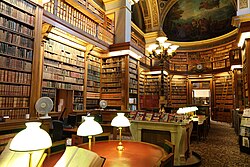
Copyright is a type of intellectual property that gives its owner the exclusive right to brand copies of a creative work, usually for a express fourth dimension.[128] [129] [130] [131] [132] The creative work may be in a literary, artistic, educational, or musical class. Copyright is intended to protect the original expression of an idea in the form of a artistic work, only not the idea itself.[133] [134] [135]
United Kingdom [edit]
Literary works have been protected by copyright law from unauthorized reproduction since at least 1710.[136] Literary works are defined past copyright law to mean "whatever work, other than a dramatic or musical work, which is written, spoken or sung, and accordingly includes (a) a table or compilation (other than a database), (b) a estimator program, (c) preparatory blueprint material for a computer program, and (d) a database."[137]
Literary works are all works of literature; that is all works expressed in print or writing (other than dramatic or musical works).[138]
United States [edit]
The copyright law of the United states has a long and complicated history, dating back to colonial times. It was established as federal police force with the Copyright Act of 1790. This act was updated many times, including a major revision in 1976.
European Matrimony [edit]
The copyright law of the European union is the copyright law applicable within the European Spousal relationship. Copyright constabulary is largely harmonized in the Union, although state to country differences exist. The body of police was implemented in the Eu through a number of directives, which the fellow member states need to enact into their national law. The main copyright directives are the Copyright Term Directive, the Information Society Directive and the Directive on Copyright in the Digital Single Market. Copyright in the Wedlock is furthermore dependent on international conventions to which the European Wedlock is a member (such as the TRIPS Agreement and conventions to which all Member States are parties (such as the Berne Convention)).
Copyright in communist countries [edit]
Copyright in Nippon [edit]
Nippon was a political party to the original Berne convention in 1899, so its copyright law is in sync with most international regulations. The convention protected copyrighted works for 50 years afterward the author's death (or 50 years after publication for unknown authors and corporations). However, in 2004 Japan extended the copyright term to 70 years for cinematographic works. At the end of 2018, as a result of the Trans-Pacific Partnership negotiations, the 70 yr term was applied to all works.[139] This new term is non applied retroactively; works that had entered the public domain between 1999 and 2018 past expiration would remain in the public domain.
Censorship [edit]

Is a means employed by states, religious organizations, educational institutions, etc, to control what tin be portrayed, spoken, performed, or written.[140] By and large such bodies attempt to ban works for political reasons, or because they deal with other controversial matters such as race, or sex.[141]
A notorious example of censorship is James Joyce'due south novel Ulysses, which has been described by Russian-American novelist Vladimir Nabokov equally a "divine work of art" and the greatest masterpiece of 20th century prose.[142] Information technology was banned in the United States from 1921 until 1933 on the grounds of obscenity. Present it is a fundamental literary text in English literature courses, throughout the globe.[143]
Awards [edit]
There are numerous awards recognizing achievement and contribution in literature. Given the diversity of the field, awards are typically limited in scope, unremarkably on: grade, genre, linguistic communication, nationality and output (east.g. for starting time-time writers or debut novels).[144]
The Nobel Prize in Literature was one of the six Nobel Prizes established by the will of Alfred Nobel in 1895,[145] and is awarded to an author on the ground of their torso of work, rather than to, or for, a particular work itself.[annotation two] Other literary prizes for which all nationalities are eligible include: the Neustadt International Prize for Literature, the Human being Booker International Prize, Pulitzer Prize, Hugo Award, Guardian First Book Accolade and the Franz Kafka Prize.
See besides [edit]
- Library
- Literary agent
- Literary element
- Literary mag
- Reading
- Rhetorical modes
- Science fiction § As serious literature
- Vernacular literature
Notes [edit]
- ^ The definition of rhetoric is a controversial field of study within the field and has given rise to philological battles over its meaning in Ancient Greece.[26]
- ^ Still, in some instances a work has been cited in the caption of why the award was given.
References [edit]
- ^ "Literature: definition". Oxford Learner's Dictionaries.
- ^ "Oral literature". Encyclopaedia Britannica. ; see too Homer.
- ^ a b "literature | Definition, Characteristics, Genres, Types, & Facts". Encyclopedia Britannica.
- ^ a b OED
- ^ "literature (n.)". Online Etymology Dictionary. Retrieved 9 February 2014.
- ^ Meyer, Jim (1997). "What is Literature? A Definition Based on Prototypes". Work Papers of the Summertime Found of Linguistics and University of North Dakota Session. 41 (1). Retrieved 11 February 2014. [ expressionless link ]
- ^ Finnegan, Ruth (1974). "How Oral Is Oral Literature?". Bulletin of the School of Oriental and African Studies. 37 (1): 52–64. doi:10.1017/s0041977x00094842. JSTOR 614104. S2CID 190730645. (subscription required)
- ^ Leitch et al., The Norton Anthology of Theory and Criticism, 28
- ^ Eagleton 2008, p. 9.
- ^ Biswas, Critique of Poetics, 538
- ^ "Oral literature". Encyclopedia Britannica.
- ^ a b John Miles Foley. "What's in a Sign" (1999). Due east. Anne MacKay (ed.). Signs of Orality. BRILL Academic. pp. 1–2. ISBN978-9004112735.
- ^ Francis, Norbert (2017). Bilingual and multicultural perspectives on poetry, music and narrative: The science of fine art. Lanham MD: Rowman and Littlefield.
- ^ Donald S. Lopez Jr. (1995). "Authority and Orality in the Mahāyāna" (PDF). Numen. Brill Academic. 42 (one): 21–47. doi:10.1163/1568527952598800. hdl:2027.42/43799. JSTOR 3270278.
- ^ a b Johnson, Sian (26 February 2020). "Study dates Victorian volcano that cached a human-made axe". ABC News . Retrieved 9 March 2020.
- ^ Matchan, Erin Fifty.; Phillips, David; Jourdan, Fred; Oostingh, Korien (2020). "Early human occupation of southeastern Australia: New insights from 40Ar/39Ar dating of young volcanoes". Geology. 48 (4): 390–394. Bibcode:2020Geo....48..390M. doi:10.1130/G47166.one. ISSN 0091-7613. S2CID 214357121.
- ^ Reece, Steve. "Orality and Literacy: Ancient Greek Literature as Oral Literature," in David Schenker and Martin Hose (eds.), Companion to Greek Literature (Oxford: Blackwell, 2015) 43-57. Ancient_Greek_Literature_as_Oral_Literature
- ^ Michael Gagarin (1999). E. Anne MacKay (ed.). Signs of Orality. BRILL Academic. pp. 163–164. ISBN978-9004112735.
- ^ Wolfgang Kullmann (1999). E. Anne MacKay (ed.). Signs of Orality. BRILL Academic. pp. 108–109. ISBN978-9004112735.
- ^ John Scheid (2006). Clifford Ando and Jörg Rüpke (ed.). Faith and Law in Classical and Christian Rome. Franz Steiner Verlag. pp. 17–28. ISBN978-3-515-08854-1.
- ^ Kroeber, Karl, ed. (2004). Native American Storytelling: A Reader of Myths and Legends . Malden, MA: Blackwell Publishing. pp. ane. ISBN978-i-4051-1541-iv.
- ^ Kroeber, Karl, ed. (2004). Native American Storytelling: A Reader of Myths and Legends . Malden, MA: Blackwell Publishing. pp. 3. ISBN978-i-4051-1541-4.
- ^ a b c Kroeber, Karl, ed. (2004). Native American Storytelling: A Reader of Myths and Legends . Malden, MA: Blackwell Publishing. pp. 2. ISBN978-1-4051-1541-iv.
- ^ Doucleff, Michaeleen; Greenhalgh, Jane (13 March 2019). "How Inuit Parents Teach Kids To Control Their Anger". NPR . Retrieved 29 April 2019.
- ^ Run across, e.g., Thomas Conley, Rhetoric in the European Tradition (University of Chicago, 1991).
- ^ Come across, for instance Parlor, Burkean; Johnstone, Henry W. (1996). "On schiappa versus poulakos". Rhetoric Review. 14 (two): 438–440. doi:10.1080/07350199609389075.
- ^ Greenish, 1000.W. (1981). "The Construction and Implementation of the Cuneiform Writing Arrangement". Visible Linguistic communication. 15 (4): 345–372.
- ^ Foster 2001, p. 19.
- ^ Blackness et al. The Literature of Ancient Sumer, 19
- ^ Foster 2001, p. vii.
- ^ Lichtheim, Miriam (1975). Ancient Egyptian Literature, vol ane. London, England: University of California Press. ISBN 0-520-02899-6.
- ^ Jacobs 1888 harvnb error: no target: CITEREFJacobs1888 (assistance), Introduction, page fifteen; Ryder 1925 harvnb fault: no target: CITEREFRyder1925 (help), Translator's introduction, quoting Hertel: "the original work was composed in Kashmir, about 200 B.C. At this date, however, many of the private stories were already aboriginal."
- ^ Ryder 1925 harvnb error: no target: CITEREFRyder1925 (aid) Translator'south introduction: "The Panchatantra is a niti-shastra, or textbook of niti. The give-and-take niti ways roughly "the wise conduct of life." Western civilization must endure a certain shame in realizing that no precise equivalent of the term is institute in English language, French, Latin, or Greek. Many words are therefore necessary to explain what niti is, though the idea, once grasped, is clear, important, and satisfying."
- ^ Baxter (1992), p. 356. sfnp error: no target: CITEREFBaxter1992 (assist)
- ^ Allan (1991), p. 39. sfnp error: no target: CITEREFAllan1991 (assist)
- ^ Zheng Xuan 鄭玄 (Advertizement 127–200), Shipu xu 詩譜序.
- ^ A Hyatt Mayor, Prints and People, Metropolitan Museum of Fine art/Princeton, 1971, nos 1–4. ISBN 0-691-00326-2
- ^ "Chinese philosophy", Encyclopædia Britannica, online
- ^ Lin, Liang-Hung; Ho, Yu-Ling (2009). "Confucian dynamism, culture and ethical changes in Chinese societies – a comparative study of China, Taiwan, and Hong Kong". The International Journal of Human being Resource Management. twenty (11): 2402–2417. doi:ten.1080/09585190903239757. ISSN 0958-5192. S2CID 153789769.
- ^ see east.g. Radhakrishnan & Moore 1957, p. 3 harvnb error: no target: CITEREFRadhakrishnanMoore1957 (aid); Witzel, Michael, "Vedas and Upaniṣads ", in: Inundation 2003, p. 68 harvnb error: no target: CITEREFFlood2003 (assistance); MacDonell 2004, pp. 29–39 harvnb error: no target: CITEREFMacDonell2004 (help); Sanskrit literature (2003) in Philip's Encyclopedia. Accessed 2007-08-09
- ^ Sanujit Ghose (2011). "Religious Developments in Aboriginal Bharat" in Ancient History Encyclopedia.
- ^ Gavin Flood sums up mainstream estimates, according to which the Rigveda was compiled from equally early equally 1500 BC over a period of several centuries. Alluvion 1996, p. 37
- ^ James K. Lochtefeld (2002). The Illustrated Encyclopedia of Hinduism: A-M. The Rosen Publishing Group. p. 399. ISBN978-0-8239-3179-8.
- ^ T. R. S. Sharma; June Gaur; Sahitya Akademi (New Delhi, Inde). (2000). Aboriginal Indian Literature: An Anthology. Sahitya Akademi. p. 137. ISBN978-81-260-0794-3.
- ^ "Ramayana | Summary, Characters, & Facts". Encyclopedia Britannica . Retrieved 18 February 2020.
- ^ Lutgendorf 1991, p. one.
- ^ Chadwick, John (1967). The Decipherment of Linear B (Second ed.). Cambridge, England: Cambridge University Press. p. 101. ISBN978-1-107-69176-6. "The glimpse we accept of a sudden been given of the business relationship books of a long-forgotten people..."
- ^ a b c Ventris, Michael; Chadwick, John (1956). Documents in Mycenaean Greek. Cambridge, England: Cambridge University Printing. p. xxix. ISBN978-1-107-50341-0.
- ^ Croally, Neil; Hyde, Roy (2011). Classical Literature: An Introduction. Routledge. p. 26. ISBN978-1136736629 . Retrieved 23 November 2016.
- ^ Wilson, Nigel (2013). Encyclopedia of Ancient Hellenic republic. Routledge. p. 366. ISBN978-1136788000 . Retrieved 22 November 2016.
- ^ Romilly, Jacqueline de (1985). A Brusque History of Greek Literature. Academy of Chicago Press. p. one. ISBN978-0226143125 . Retrieved 22 November 2016.
- ^ Graziosi, Barbara (2002). Inventing Homer: The Early Reception of Epic. Cambridge Academy Press. p. 15. ISBN978-0521809665 . Retrieved 22 November 2016.
- ^ Ahl, Frederick; Roisman, Hanna (1996). The Odyssey Re-formed. Cornell Academy Press. ISBN978-0801483356 . Retrieved 23 November 2016.
- ^ Latacz, Joachim (1996). Homer, His Art and His Earth. University of Michigan Press. ISBN978-0472083534 . Retrieved 22 November 2016.
- ^ Too, Yun Lee (2010). The Idea of the Library in the Ancient Earth. OUP Oxford. p. 86. ISBN978-0199577804 . Retrieved 22 November 2016.
- ^ MacDonald, Dennis R. (1994). Christianizing Homer: The Odyssey, Plato, and the Acts of Andrew. Oxford University Printing. p. 17. ISBN978-0195358629. Archived from the original on 30 June 2017. Retrieved 22 November 2016.
- ^ Aristophanes: Butts K.J.Dover (ed), Oxford University Press 1970, Intro. p. x.
- ^ Frei 2001, p. 6. sfn error: no target: CITEREFFrei2001 (aid)
- ^ Romer 2008, p. 2 and fn.iii. sfn error: no target: CITEREFRomer2008 (help)
- ^ Riches, John (2000). The Bible: A Very Short Introduction. Oxford: Oxford Academy Press. p. 134. ISBN978-0-19-285343-1.
- ^ Duckworth, George Eckel. The nature of Roman comedy: a report in popular entertainment. University of Oklahoma Press, 1994. p. 3. Web. 15 October 2011.
- ^ Donner, Fred (2010). Muhammad and the Believers: at the Origins of Islam . London, England: Harvard University Printing. pp. 153–154. ISBN978-0-674-05097-6.
- ^ "الوثائقية تفتح ملف "اللغة العربية"". الجزيرة الوثائقية (in Arabic). 8 September 2019. Retrieved xviii June 2020.
- ^ "Western literature - Medieval literature". Encyclopedia Britannica.
- ^ Elizabeth L. Eisenstein, The Printing Printing every bit an Agent of Change. Cambridge Academy Press, 1980
- ^ Margaret Anne Doody, The True Story of the Novel. New Brunswick, NJ: Rutgers University Press, 1996, rept. 1997, p. 1. Retrieved 21 Oct 2020.
- ^ Clapham, Michael, "Press" in A History of Technology, Vol 2. From the Renaissance to the Industrial Revolution, edd. Charles Singer et al. (Oxford 1957), p. 377. Cited from Elizabeth L. Eisenstein, The Press Press equally an Agent of Change (Cambridge Academy, 1980).
- ^ "Court: Institutionalizing English Literature". oldsite.english language.ucsb.edu.
- ^ "Women and Literature". www.ibiblio.org.
- ^ Saturday Review. Saturday Review. 1876. pp. 771ff.
- ^ Hart, Kathleen (2004). Revolution and Women's Autobiography in Nineteenth-century France. Rodopi. p. 91.
- ^ Lewis, Linda Thousand. (2003). Germaine de Staël, George Sand, and the Victorian Woman Artist. University of Missouri Press. p. 48.
- ^ Eisler, Benita (8 June 2018). "'George Sand' Review: Monstre Sacré". WSJ . Retrieved 6 November 2018.
- ^ Thomson, Patricia (July 1972). "George Sand and English Reviewers: The First Twenty Years". Modern Language Review. 67 (iii): 501–516. doi:10.2307/3726119. JSTOR 3726119.
- ^ Forsas-Scott, Helena (1997). Swedish Women's Writing 1850-1995. London: The Athlone Press. p. 63. ISBN0485910039.
- ^ Nikolajeva, María, ed. (1995). Aspects and Issues in the History of Children's Literature. Greenwood. ISBN978-0-313-29614-vii.
- ^ •Lyons, Martyn. 2011. Books: a living history. Los Angeles: J. Paul Getty Museum.
- ^ Sullivan, Patrick (one January 2002). ""Reception Moments," Modern Literary Theory, and the Didactics of Literature". Journal of Adolescent & Developed Literacy. 45 (7): 568–577. JSTOR 40012241.
- ^ Matthew Schneider-Mayerson, "Popular Fiction Studies: The Advantages of a New Field". Studies in Popular Civilization, Vol. 33, No. i (Autumn 2010), pp. 21-iii
- ^ Boyd, William. "A short history of the short story". Retrieved 17 April 2018.
- ^ "The Nobel Prize in Literature". nobelprize.org.
- ^ John Sutherland (13 October 2007). "Ink and Spit". Guardian Unlimited Books. The Guardian. Retrieved 13 October 2007.
- ^ Oebel, Guido (2001). So-called "Alternative FLL-Approaches". Norderstedt: Smile Verlag. ISBN9783640187799.
- ^ Makin, Michael; Kelly, Catriona; Shepher, David; de Rambures, Dominique (1989). Discontinuous Discourses in Mod Russian Literature. New York: Palgrave Macmillan. p. 122. ISBN9781349198511.
- ^ Cullingford, Cedric (1998). Children's Literature and its Effects. London: A&C Black. p. 5. ISBN0304700924.
- ^ Hogan 2011, p. ten.
- ^ Hogan 2011, p. 11.
- ^ Damon, William; Lerner, Richard; Renninger, Ann; Sigel, Irving (2006). Handbook of Child Psychology, Child Psychology in Practise. Hoboken, NJ: John Wiley & Sons. p. 90. ISBN0471272876.
- ^ Paris 1986, p. 61.
- ^ Paris 1986, p. 25.
- ^ Nezami, S.R.A. (February 2012). "The use of figures of spoken communication as a literary device—a specific style of expression in English literature". Language in India. 12 (2): 659–. [ dead link ]
- ^ Riches, John (2021) [2000]. "The Bible in high and popular civilization". The Bible: a Very Brusk Introduction. Book 14 in Very Brusk Introductions Series (two ed.). Oxford: Oxford Academy Printing. p. 115. ISBN9780198863335 . Retrieved 23 February 2022.
In its various translations, [the Bible] has had a formative influence on the language, the literature, the art, the music of all the major European and N American cultures. It continues to influence popular culture in films, novels, and music.
- ^ "Islamic arts - Islamic literatures". Encyclopedia Britannica.
- ^ Riches, John (2000). The Bible: A Very Brusque Introduction. Oxford: Oxford University Press. p. 134. ISBN978-0-19-285343-1.
- ^ "Hinduism - Vernacular literatures". Encyclopedia Britannica.
- ^ "When the Rex Saved God". Vanity Fair. 2011. Retrieved x Baronial 2017.
- ^ "Why I want all our children to read the Rex James Bible". The Guardian. xx May 2012. Retrieved 10 August 2017.
- ^ a b "verse, n." Oxford English Dictionary. OUP. Retrieved 13 February 2014. (subscription required)
- ^ a b Preminger 1993, p. 938.
- ^ a b Preminger 1993, p. 939.
- ^ Preminger 1993, p. 981.
- ^ Preminger 1993, p. 979.
- ^ Lipsky, Abram (1908). "Rhythm in Prose". The Sewanee Review. 16 (3): 277–289. JSTOR 27530906. (subscription required)
- ^ Ross, "The Emergence of 'Literature': Making and Reading the English Catechism in the Eighteenth Century", 398
- ^ Finnegan, Ruth H. (1977). Oral poetry: its nature, significance, and social context. Indiana Academy Press. p. 66.
- ^ Magoun, Jr., Francis P. (1953). "Oral-Formulaic Grapheme of Anglo-Saxon Narrative Verse". Speculum. 28 (3): 446–467. doi:ten.2307/2847021. JSTOR 2847021. S2CID 162903356. (subscription required)
- ^ Alison Booth; Kelly J. Mays. "Glossary: P". LitWeb, the Norton Introduction to Literature Studyspace. Archived from the original on 18 March 2011. Retrieved 15 Feb 2014.
- ^ Eliot T.Due south. 'Poetry & Prose: The Chapbook. Poetry Bookshop: London, 1921.
- ^ For discussion of the basic chiselled issues see The New Princeton Encyclopedia of Poetry and Poetics (Princeton, NJ: Princeton University Press, 1993), due south.v. 'Narrative Verse'.
- ^ Graff, Richard (2005). "Prose versus Verse in Early on Greek Theories of Way". Rhetorica. 23 (iv): 303–335. doi:10.1525/rh.2005.23.4.303. JSTOR 10.1525/rh.2005.23.4.303. (subscription required)
- ^ "Literature", Encyclopaedia Britannica. online
- ^ Sommerville, C. J. (1996). The News Revolution in England: Cultural Dynamics of Daily Information. Oxford: OUP. p. 18.
- ^ "Essay on Romance", Prose Works book half dozen, p. 129, quoted in "Introduction" to Walter Scott'south Quentin Durward, ed. Susan Maning. Oxford: Oxford University Press, 1992, p. xxv. Romance should non exist confused with Harlequin Romance.
- ^ Doody (1996), p. 15.
- ^ a b "The Novel". A Guide to the Study of Literature: A Companion Text for Cadre Studies half dozen, Landmarks of Literature. Brooklyn College. Retrieved 22 February 2014.
- ^ Goody 2006, p. xix.
- ^ Goody 2006, p. 20.
- ^ Goody 2006, p. 29.
- ^ Franco Moretti, ed. (2006). "The Novel in Search of Itself: A Historical Morphology". The Novel, Volume ii: Forms and Themes. Princeton: Princeton UP. p. 31. ISBN978-0-691-04948-9.
- ^ Antrim, Taylor (2010). "In Praise of Short". The Daily Animate being . Retrieved xv February 2014.
- ^ "What'due south the definition of a "novella," "novelette," etc.?". Science Fiction and Fantasy Writers of America. Archived from the original on 19 March 2009.
- ^ Boyd, William. "A short history of the short story". Prospect Magazine. Retrieved 8 March 2014.
- ^ Colibaba, Ştefan (2010). "The Nature of the Short Story: Attempts at Definition" (PDF). Synergy. 6 (2): 220–230. Retrieved half-dozen March 2014.
- ^ Susan B. Neuman; Linda B. Gambrell, eds. (2013). Quality Reading Instruction in the Historic period of Common Cadre Standards. International Reading Association. p. 46. ISBN9780872074965.
- ^ J. A. Cuddon, Penguin Dictionary of Literary Terms and Literary Theory,p. 472.
- ^ Elam, Kier (1980). The Semiotics of Theatre and Drama . London and New York: Methuen. p. 98. ISBN978-0-416-72060-0.
- ^ Cody, Gabrielle H. (2007). The Columbia Encyclopedia of Mod Drama (Volume 1 ed.). New York Metropolis: Columbia University Press. p. 271.
- ^ "Definition of copyright". Oxford Dictionaries. Retrieved 20 Dec 2018.
- ^ "Definition of Copyright". Merriam-Webster . Retrieved xx Dec 2018.
- ^ Nimmer on Copyright, vol. two, § 8.01.
- ^ "Intellectual holding", Black's Law Dictionary, 10th ed. (2014).
- ^ "Understanding Copyright and Related Rights" (PDF). www.wipo.int. p. 4. Retrieved 6 December 2018.
- ^ Stim, Rich (27 March 2013). "Copyright Nuts FAQ". The Eye for Internet and Lodge Off-white Use Project. Stanford University. Retrieved 21 July 2019.
- ^ Daniel A. Tysver. "Works Unprotected by Copyright Police force". Bitlaw.
- ^ Lee A. Hollaar. "Legal Protection of Digital Information". p.Chapter one: An Overview of Copyright, Section 2.East. Ideas Versus Expression.
- ^ The Statute of Anne 1710 and the Literary Copyright Deed 1842 used the term "book". Nonetheless, since 1911 the statutes have referred to literary works.
- ^ "Copyright, Designs and Patents Deed 1988". legislation.gov.united kingdom . Retrieved 11 October 2021.
- ^ "University of London Press five. University Tutorial Press" [1916]
- ^ Agency for Cultural Affairs. 環太平洋パートナーシップ協定の法律) (PDF) (in Japanese). Agency for Cultural Diplomacy. Retrieved 4 Jan 2019.
- ^ J. A, Cuddon, "Censorship", The Penguin Dictionary of Literary Terms and Literary Theory (1977), (revised by C. Eastward. Preston. Penguin Books, 1998, pp. 118-22.
- ^ "About Banned & Challenged Books". ala.org. 25 Oct 2016.
- ^ Nabokov, pp. 55, 57
- ^ Ulysses has been called "the near prominent landmark in modernist literature", a work where life's complexities are depicted with "unprecedented, and unequalled, linguistic and stylistic virtuosity". The New York Times guide to essential knowledge, 3d ed. (2011), p. 126.
- ^ John Stock; Kealey Rigden (fifteen October 2013). "Human Booker 2013: Tiptop 25 literary prizes". The Telegraph. Archived from the original on 15 Oct 2013. Retrieved 8 March 2014.
- ^ "Facts on the Nobel Prize in Literature". Nobelprize.org. Nobel Media AB. Retrieved 8 March 2014.
Bibliography [edit]
- A.R. Biswas (2005). Critique of Poetics (vol. 2). Atlantic Publishers & Dist. ISBN978-81-269-0377-i.
- Jeremy Black; Graham Cunningham; Eleanor Robson, eds. (2006). The literature of ancient Sumer. Oxford: OUP. ISBN978-0-19-929633-0.
- Cain, William E.; Finke, Laurie A.; Johnson, Barbara East.; McGowan, John; Williams, Jeffrey J. (2001). Vincent B. Leitch (ed.). The Norton Anthology of Theory and Criticism . Norton. ISBN978-0-393-97429-4.
- Eagleton, Terry (2008). Literary Theory: An Introduction (Anniversary, 2nd ed.). Oxford: Blackwell Publishing. ISBN978-1-4051-7921-8.
- Flood, Gavin (1996). An Introduction to Hinduism . Cambridge University Press. ISBN978-0-521-43878-0.
- Hogan, P. Colm (2011). What Literature Teaches Us about Emotion. New York: Cambridge University Press.
- Foster, John Lawrence (2001), Ancient Egyptian Literature: An Album, Austin: University of Texas Press, p. twenty, ISBN978-0-292-72527-0
- Giraldi, William (2008). "The Novella's Long Life" (PDF). The Southern Review: 793–801. Archived from the original (PDF) on 22 February 2014. Retrieved 15 February 2014.
- Goody, Jack (2006). "From Oral to Written: An Anthropological Breakthrough in Storytelling". In Franco Moretti (ed.). The Novel, Volume one: History, Geography, and Civilization. Princeton: Princeton Up. p. 18. ISBN978-0-691-04947-two.
- Paris, B.J. (1986). Tertiary Strength Psychology and the Written report of Literature. Cranbury: Associated University Press.
- Preminger, Alex; et al. (1993). The New Princeton Encyclopedia of Verse and Poetics . US: Princeton University Printing. ISBN978-0-691-02123-ii.
- Ross, Trevor (1996). "The Emergence of "Literature": Making and Reading the English language Canon in the Eighteenth Century."" (PDF). ELH. 63 (ii): 397–422. doi:ten.1353/elh.1996.0019. S2CID 170813833. Retrieved 9 Feb 2014.
Further reading [edit]
- Bonheim, Helmut (1982). The Narrative Modes: Techniques of the Short Story. Cambridge: Brewer. An overview of several hundred brusk stories.
- Gillespie, Gerald (January 1967). "Novella, nouvelle, novella, short novel? — A review of terms". Neophilologus. 51 (1): 117–127. doi:10.1007/BF01511303. S2CID 162102536.
- Wheeler, L. Kip. "Periods of Literary History" (PDF). Carson-Newman Academy. Retrieved 18 March 2014. Cursory summary of major periods in literary history of the Western tradition.
External links [edit]
- Project Gutenberg Online Library
- Internet Book Listing similar to IMDb but for books
- Cyberspace Archive Digital eBook Collection
Source: https://en.wikipedia.org/wiki/Literature
0 Response to "Study Spanish Art Sketchbookcollage Math Hw Read American Lit Book History Project"
Post a Comment