Framed Wall Art Jefferson Franklin Writing the Declaration of Independence 1776
| Declaration of Independence | |
|---|---|
 | |
| Creative person | John Trumbull |
| Yr | commissioned 1817; purchased 1819; engagement of creation 1818; placed in the Rotunda 1826 |
| Medium | Oil-on-sheet |
| Dimensions | 3.seven g × 5.5 m (12 ft × 18 ft) |
| Location | U.Southward. Capitol, Washington, D.C., U.S. |
Annunciation of Independence is a 12-by-18-human foot (3.7 past 5.5 m) oil-on-canvas painting by the American artist John Trumbull depicting the presentation of the typhoon of the Declaration of Independence to Congress. It was based on a much smaller version of the aforementioned scene, presently held by the Yale University Art Gallery.[ane] Trumbull painted many of the figures in the picture from life, and visited Independence Hall to describe the chamber where the Second Continental Congress met. The oil-on-canvas work was commissioned in 1817, purchased in 1819, and placed in the United States Capitol rotunda in 1826.
The painting is sometimes incorrectly described as depicting the signing of the Proclamation of Independence. The painting shows the five-human drafting committee presenting their typhoon of the Declaration to the Congress, an event that took place on June 28, 1776, and non its signing, which took place mainly on August ii.[2]
The painting shows 42 of the 56 signers of the Declaration; Trumbull originally intended to include all 56 signers but was unable to obtain likenesses for all of them. He also depicted several participants in the fence who did non sign the certificate, including John Dickinson, who declined to sign. Trumbull had no portrait of Benjamin Harrison V to work with, merely his son Benjamin Harrison VI was said to resemble his father, so Trumbull painted him instead. Similarly, Trumbull painted Rufus Hopkins, who resembled his begetter Stephen Hopkins, for whom no portrait was available. Every bit the Proclamation was debated and signed over a period of time when membership in Congress changed, the men featured in the painting never were in the same room at the aforementioned fourth dimension.
Although Thomas Jefferson appears to be stepping on John Adams' shoe in the painting, which many thought symbolized their human relationship as friendly rivals, upon closer examination it can exist seen that their feet are but close together. This part of the prototype was correctly depicted on the ii-dollar bill version.
On the farthest wall hangs a display of trumpets, drum, and regimental colours captured from British regiments. This is not depicted in all versions, most notably the i seen on the two-dollar beak.
Key to historical figures depicted in the painting [edit]

Trumbull'south Declaration of Independence
 Clickable image: Betoken at a face to identify the person, click to go to the corresponding article.
Click anywhere else in the image to get to the image's file folio and view a larger version.

U.Due south. authorities'southward key to the painting
The post-obit key to the 47 figures in the painting follows the numbering used by the U.S. government publication "Art of the Capitol" (in the illustration of the key shown in this section) but provides a unlike (hopefully clearer) clarification of which figure is where in the painting, so numbers are not entirely in order.
Key to figures (in each group, listed from left to right):
Four men seated on the far left:
- 1. George Wythe
- 2. William Whipple
- iii. Josiah Bartlett
- 5. Thomas Lynch Jr.
Seated at the table on the left:
- four. Benjamin Harrison
Seated together to the correct of Harrison and in front of the standing figures:
- 6. Richard Henry Lee
- 7. Samuel Adams
- 8. George Clinton

Five figures standing together on the left:
- 9. William Paca
- 10. Samuel Chase
- 11. Lewis Morris
- 12. William Floyd
- 13. Arthur Middleton
Three seated figures in the back between the 2 sets of continuing figures:
- 14. Thomas Heyward Jr.
- 15. Charles Carroll
- 16. George Walton
Prepare of iii figures standing together in the back:
- 23. Stephen Hopkins (wearing a hat)
- 24. William Ellery
- 25. George Clymer
Ten figures seated:
- 17. Robert Morris (get-go on the left at the table)
- xviii. Thomas Willing
- 19. Benjamin Rush
- 20. Elbridge Gerry
- 21. Robert Care for Paine
- 22. Abraham Clark
- 26. William Hooper
- 27. Joseph Hewes
- 28. James Wilson
- 29. Francis Hopkinson
V figures standing in front (the Committee of 5):
- 30. John Adams
- 31. Roger Sherman
- 32. Robert R. Livingston
- 33. Thomas Jefferson
- 34. Benjamin Franklin
4 background figures seated together nearly the right corner of the room:
- 35. Richard Stockton
- 36. Francis Lewis
- 37. John Witherspoon
- 38. Samuel Huntington
Two figures standing in the right corner of the room:
- 39. William Williams
- 40. Oliver Wolcott
Two foreground figures at the cardinal table:
- 42. Charles Thomson (standing)
- 41. John Hancock (seated)
Three figures standing at right:
- 43. George Read
- 44. John Dickinson
- 45. Edward Rutledge
2 figures seated at far correct:
- 46. Thomas McKean
- 47. Philip Livingston
(Note: - Non a signer of the final Declaration of Independence but depicted in painting. Although Charles Thomson was i of 2 members listed past name in the earlier Dunlap Broadside as having attested to the Proclamation, and many historians believe he had signed the original document that was lost. Clinton was not present at the signing of the Declaration.)
Unpainted signers [edit]
At that place were 14 signers of the Proclamation who did not appear in the painting:
- Matthew Thornton (New Hampshire)
- John Hart (New Jersey)
- John Morton (Pennsylvania)
- James Smith (Pennsylvania)
- George Taylor (Pennsylvania)
- George Ross (Pennsylvania)
- Caesar Rodney (Delaware)
- Thomas Stone (Maryland)
- Thomas Nelson, Jr. (Virginia)
- Francis Lightfoot Lee (Virginia)
- Carter Braxton (Virginia)
- John Penn (North Carolina)
- Button Gwinnett (Georgia)
- Lyman Hall (Georgia)
On U.S. currency and postage stamps [edit]
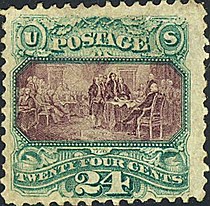
The painting was pictured on an 1869 United States 24-cent definitive postage stamp
Trumbull's Declaration of Independence signing scene painting has been depicted several times on United States currency and postage stamps. It was first used on the reverse side of the $100 National Bank Note that was issued in 1863.[3] The depiction was engraved by Frederick Girsch of the American Bank Note Company.[four] The same steel engraving was used on the 24¢ stamp issued six years later as office of the 1869 pictorial series of definitive U.Due south. stamp stamps.[5]
Trumbull'southward painting is presently depicted on the reverse of the two-dollar bill. Featured in it are 40 of the 47 figures from Trumbull's painting. Cut out from the scene are: the farthest four figures on the left—George Wythe, William Whipple, Josiah Bartlett, and Thomas Lynch, Jr.; the farthest two figures on the right—Thomas McKean and Philip Livingston; and one of three figures seated in the left rear—George Walton. Additionally, ii unrecognized figures were added: one in between Samuel Chase and Lewis Morris and another between James Wilson and Francis Hopkinson, bringing the total number of figures shown in this presentation scene to 42.
Other versions [edit]

The Proclamation of Independence, July four, 1776, John Trumbull, (1786–1820), Yale University Fine art Gallery
Trumbull painted a smaller version (only xx.875 past 31 inches (53.02 cm × 78.74 cm)) entitled The Declaration of Independence, July 4, 1776 (1786–1820) that is now on view at the Yale University Art Gallery in New Haven, Connecticut.[i]
Legacy and interpretations [edit]
In 2017, the company Beginnings.com restaged the painting with the 29 living descendants of the men depicted in Trumbull's painting equally part of an advertising entrada called "Declaration Descendants".[6] [seven] The entrada included 2 brusque films and ran on digital and social media platforms. Shannon Lanier, a descendant of Thomas Jefferson, said: "When you meet the new picture show, the new image, it'southward a picture of diverse people. Blackness, white, Hispanic, Native American—a lilliputian fleck of everything—Asian, and that'south more than of a representation of this land."[8]
In the 2008 HBO miniseries John Adams, in i of the final scenes of the series, the painter John Trumbull is showing his massive mural to an elderly John Adams for his approval. While staring at the painting Adams mentions, "They're all expressionless ... except me and Jefferson." He then expresses to Trumbull his disapproval of the work. This leads to a cursory argument between the men well-nigh the divergence between artistic license and historical accurateness. The scene itself is entirely fictional, just serves as a alarm towards the fictionalization of the past itself with Adams stating "It is very bad history".[ix]
Run across also [edit]
- Congress Voting Independence, a similar painting past Robert Border Pino, 1784-1788
- Declaration of Independence Tablet, Boston Common
- Scene at the Signing of the Constitution of the The states – a 1940 painting depicting members of the 1787 Constitutional Convention by Howard Chandler Christy.
- Founding Fathers of the Usa
- Syng inkstand, pictured in the painting
References [edit]
- ^ a b Trumbull, John. "The Announcement of Independence, July four, 1776". Yale Academy Art Gallery.
- ^ John Hazelton, "The Historical Value of Trumbull's - 'Declaration of Independence' ", The Pennsylvania Magazine of History and Biography - Volume 31, (Historical Social club of Pennsylvania, 1907), 38.
- ^ "History Timeline". Bureau of Engraving and Press/Treasury Website. Archived from the original on 2014-01-14.
- ^ Hessler, Gene (1993). The Engraver'due south Line – An Encyclopedia of Paper Money & Stamp Stamp Art. BNR Press. p. 137. ISBN0-931960-36-3.
- ^ Forster, Jeffrey (2012). "The Chronicle'south Banana Department Editor - 1869 Pictorial Upshot". U.S. Philatelic Classics Guild. Archived from the original on May 14, 2011. Retrieved November iii, 2015.
- ^ "'Declaration of Independence' Painting Recreated With Founders' Diverse Descendants". Observer. 2017-07-05. Retrieved 2020-07-05 .
- ^ Team, Editorial. "Meet the Descendants of America's Founding Fathers". Branding.news . Retrieved 2020-07-05 .
- ^ Quijao, Elaine (4 July 2017). "Founding Fathers' descendants unite 241 years later to re-create iconic painting". world wide web.cbsnews.com . Retrieved 2020-07-05 .
- ^ HBO'south Miniseries "John Adams" (2008). https://www.youtube.com/watch?five=DT0qNAYJQWU
External links [edit]
- Keys to the figures
- Another key to the figures
- Declaration of Independence Flash - based cardinal
- Other
- A spider web page with some information on the painting
- Architect of the Capitol Web folio on the painting
Source: https://en.wikipedia.org/wiki/Declaration_of_Independence_%28painting%29
0 Response to "Framed Wall Art Jefferson Franklin Writing the Declaration of Independence 1776"
Post a Comment