What Use of Readymade Artwork or Found Art Was a Common Quality
Beginnings
Dada

After the horrors of the First World War, many artists, writers, and intellectuals started to question every aspect of their culture that had immune it to occur. Artists started to retrieve nearly how technology, consumerism, art, and politics were all interrelated. Romanian-French poet Tristan Tzara noted, "The beginnings of Dada were not the beginnings of art, only of disgust." Artists and writers such as Tzara, Hugo Brawl, Man Ray, Hannah Höch and Max Ernst decided that the just mode to answer to these realizations was through irreverent and (potentially) nonsensical works. Dada artists used techniques such equally collage, assemblage, and photomontage to form their works, creating new linguistic and visual languages that attempted to exist outside the rigid structures of contemporary society. The term Dada itself, though contested in origin, is said to come up from its pregnant of both 'Aye, aye' in Romanian and 'rocking horse' in French, demonstrating its transnational origins. The Cabaret Voltaire in Zürich Switzerland was an early hangout for Dada artists, but the motility soon spread to Paris and so to New York.
The Found Object

The phrase "found object" is a direct translation from the French "objets trouves," meaning everyday objects inserted into an art context thus transformed from non-fine art to art. Though constitute objects had been associated with the art world pre-1900s, they were mostly included every bit pieces of overall collections such equally in Victorian taxonomy, or in cabinets of "curiosities." It wasn't until the outset of the 20thursday century that artists started incorporating them into their piece of work. Pablo Picasso is widely considered to take produced the first piece of art to incorporate plant materials when, in 1912, he used the dorsum of a chair as part of Nevertheless Life with Chair Caning. The piece was also considered 1 of the starting time collages of Constructed Cubism. By incorporating this material into his work, Picasso began to break down the barrier distinctions between art and real life by demonstrating that art is always produced from real life.
Marcel Duchamp
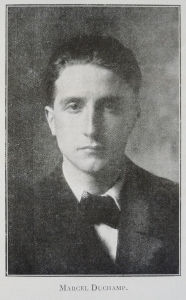
Notwithstanding, information technology was French-American artist Marcel Duchamp who took the constitute object to new heights in his theorizing of the readymade. Duchamp is understood to be the initiator of the readymade, though the term was already in use much earlier to announce objects fabricated through manufacturing processes. He had been painting since 1904 and studied at the Academie Julien in Paris between 1904-5. His early works show the influence of Cubism and looked frontward to the work of Futurists: his Nude Descending the Staircase (1912), for instance, attempted to show the body in move, suggesting the static and the active through fragmented lines.
All the same, that same yr, Duchamp began to move away from painting, rejecting what he termed "retinal art." He started developing the idea of the readymade after he placed a bike wheel on a stool ane day in his studio, and from at that place experimented with other forms including either objects he selected on their own or adapted or changed in some small way. For Duchamp, the readymade is in direct conversation with industry and manufacturing: past taking mass-made objects and elevating them by putting them in new contexts and defining them every bit fine art, he questions the very process through which something becomes art in the first place.
His most famous readymade came in 1917 when Duchamp submitted The Fountain, a plain porcelain urinal, to the Society of Contained Artists for their show of modern fine art under the pseudonym of "R. Mutt." Duchamp was part of the Board of the Society and the piece created much debate amid its members nearly its status equally art. An emergency coming together rendered it a reject and it was hidden from view in the show.
Duchamp was furious with this decision and in the post-obit calendar month, using a pseudonym, wrote a piece in The Bullheaded Man, the magazine that he co-edited, in social club to defend the work. He wrote: "Whether Mr. Mutt with his own hands made the fountain or not has no importance. He CHOSE information technology. He took an ordinary commodity of life, placed it then that its useful significance disappeared nether the new title and point of view - and created a new idea for that object." In this statement, Jonathan Jones finds a new starting point for art in the 20th century, noting, "It's as if gimmicky art history begins with him." Though he simply made thirteen readymades, this groundbreaking work set upward the foundation for the field of Conceptual Art past seeking to redefine the possibilities of fine art, in that art was not something merely to be enjoyed visually but that information technology could, instead, encompass ideas and process.
Baroness Elsa von Freytag-Loringhoven
Though Duchamp is often credited as the creator of the readymade concept, the German artist Baroness Elsa von Freytag-Loringhoven is now also thought of equally an equal pioneer. Loringhoven traveled throughout Europe, moving in bohemian creative person circles and working in various jobs as a waitress, a chorus girl, a performance artist, and later a model for photographers. Only information technology was in America that she began to develop every bit an artist. In New York she met and married Baron Leo von Freytag-Loringhoven, leading to her nickname "The Baroness". She made her first piece with a institute object in 1913, a rusted metal band, which she chosen Indelible Ornament. The Baroness went on to brand other works, including her collaboration with Morton Livingston Schamberg entitled God, in the aforementioned year as Duchamp's Fountain. Via these powerful personalities the readymade became a way through which one could challenge lodge'southward norms and expectations, providing a ways of exploring the commodification of aesthetics.
Readymade and Surrealism
Duchamp's work was extremely influential in both art theory and practice and influenced many of his contemporaries and friends. André Breton, one of the proponents of Surrealism, used and wrote nearly the found object and the readymade equally means to disrupt thinking and trigger the unconscious. In contrast to Duchamp, Breton explored society's identification of the object via an essay in 1937 entitled "The Crisis of the Object." He wanted to rethink the manner that humans interacted with objects in general, and how through techniques like estrangement or assemblage, new associations could be generated. Salvador Dalí's Lobster Phone aimed to reveal unconscious associations and desires through the juxtaposition of a phone and a plaster cast lobster. Equally well as being immediately amusing and challenging, the combination appeared to reference the language of dreams, in which new combinations of objects and ideas go commonplace.
Concepts and Styles
Originality
While repurposing existing objects into new artistic contexts, one of the almost vexing issues readymade artists face is the question of originality. What is an original piece of art? How much endeavor does an creative person have to put into a work for us to say it is a unique work of art? Can an artist truly claim ownership of a work of art if information technology already existed outside of his or her co-option of the object? These are just some of the questions readymades provoke. They likewise engage with questions about our relationships with familiar objects on a daily basis. By placing them in an art context we are sometimes led to encounter how much we take for granted that which is in front of our eyes every day.
For some critics, the idea of the readymades in and of themselves are controversial because sometimes the original works, which take been lost or damaged or worn by time, have been remade by the artists themselves or by galleries. Bicycle Wheel (1913), for example, Duchamp'due south offset readymade, has been remade three times, while the originals of many others accept been lost birthday. However, in their remaking, these pieces ask even more profound questions about originality: can we even so say that this is the same piece of work as originally displayed? What does it do to the value of art if we tin simply remake a lost work?
Humor and Visual Puns
Humor and play were regular themes in readymades, and artists oft included jokes or visual puns into their piece of work. Every bit with Dadaism, Duchamp'south work sought to subvert cultural norms and play with sense and meaning. His piece of work L.H.O.O.Q (1919) combines a visual and exact pun: the title when read aloud in French reads "elle a chaud au cul" meaning "she has a hot ass" and the image reflects a moustache and goatee, pencil-drawn onto a reproduction of Leonardo da Vinci'due south Mona Lisa. The piece of work is a playful accept on one of the Renaissance's most revered works and articulates a new creative intention to excavate new meanings from erstwhile objects, be they everyday articles or works of great import. Humor is central in this approach, as it seeks to find new means to retrieve about expression and art-making.
Aesthetics and Gustation
Readymades also play with the idea of aesthetic taste and choice. We traditionally view fine art in the context of a gallery as a purchasable item to be bought and displayed. Readymades challenge the idea of fine art as decorative by incorporating or using objects that are not identified every bit cute in whatever immediate sense. In doing this, the readymade implies that a work of fine art is non merely an aesthetic object. Duchamp suggested that in order to create a readymade one had to have an "indifferent taste," in which ane could put aside their normal criteria for beauty and try to engage with the object in a radically new manner. Past divorcing art from personal or subjective taste, Duchamp paved the way for Conceptual Fine art, in which ideas took precedence over the final aesthetic of the piece.
Mass Production
In seeking to select mass-produced objects, Duchamp and other artists considered the relationship between fine art and technology and manufacture. The 20th century saw a radical shift in the fashion that objects were fabricated through increased mechanization and the coil out of factories across the world. Mass production encourages the population to consider objects in terms of their function as opposed to beauty. Nonetheless via readymades, artists could encourage their viewers to rethink these objects and consider them for their aesthetic beauty rather than their pre-defined purpose.
After Developments
The Readymade and Neo-Dada
The readymade was used oftentimes in the tardily xxth century by artists whose work engaged with postmodernism, aiming to critique mass cultural production. Many young artists in America embraced the theories and ideas espoused past Duchamp. Robert Rauschenberg in item was very influenced by Dadaism and tended to utilise found objects in his collages as a ways of dissolving the purlieus between high and low culture. His Offset Landing Bound (1961), riffed on Duchamp's Wheel Wheel with its inclusion of a tire, while also speaking to the motorcar-obsessed culture of 1960s America. He, along with others, became known as Neo-Dadaists through their adoption of humor, play, and critique of popular culture and aesthetic gustatory modality.
Other Neo-Dadaists such as Joseph Beuys and Jasper Johns responded to the ideas of Duchamp through their creations of piece of work that disrupted or challenged the relationship between art object and gallery space. Johns' sculptures Lightbulb and Flashlight (both 1958) hearken dorsum to Duchamp's disruptive aims, while also looking backwards to artistic craft and process. Johns bought both objects, and so sculpted them into a base using metal. The works became blended readymade sculptures, farther problematizing the idea of creation, taste, and originality.
Readymades would lay of import ground for Conceptual Art in that they allowed artists to consider and refine the presentation of an thought in itself as a work of fine art. They would also continue to influence contemporary artists, most dramatically seen both in the Pop Art that emerged in the 1960s, which appropriated everyday images from pop culture and elevated them into the annals of visual art, and the Neo Geo movement which turned its spotlight on everyday objects of mass production and consumerism.
Young British Artists
In the late 80s and early on 90s, the readymade took new course through a group of artists who became known as the Young British Artists (YBAs). These artists, such as Damien Hirst, Tracey Emin, and Rachel Whiteread, were infamous for shocking work that sold for very high prices. They as well frequently looked toward mass-produced items from popular culture, or ubiquitous objects from everyday life, and experimented with placing them in new contexts. They were inspired by Duchamp's thought of "selection" and "taste," in which an object merely becomes art through the creative person's coining it fine art. The about famous readymade from this era is probably Tracey Emin'southward My Bed, which was shortlisted for the 1999 Turner Prize. Emin received much criticism because people thought the work (her actual bed and the mess around it) was lazy and did not prove any artistic skill. In response to claims that anyone could make this work, Emin responded, "Well, they didn't, did they? No one had ever washed that before."
Source: https://www.theartstory.org/definition/readymade-and-found-object/history-and-concepts/
0 Response to "What Use of Readymade Artwork or Found Art Was a Common Quality"
Post a Comment